The Shortest Commute a Kid Will Ever Make: How Three Blocks Changes Everything for Parents

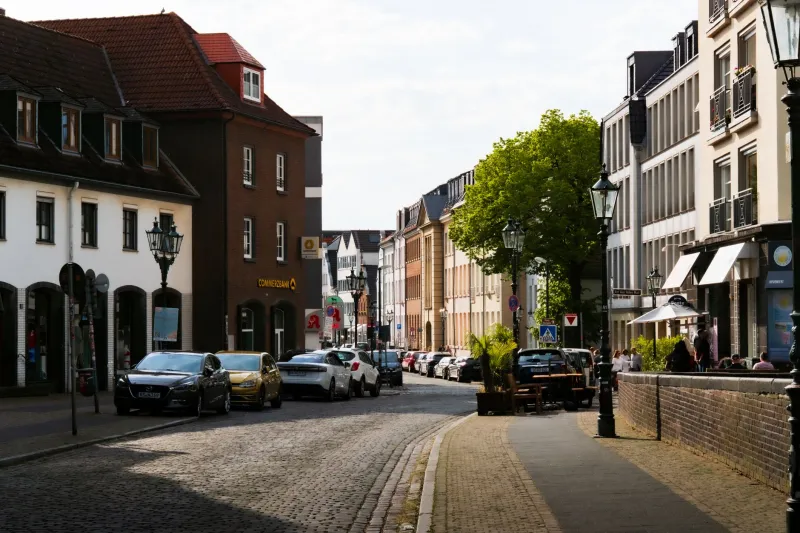
Photo: Bram Berkelmans, CC BY-SA 4.0, via Wikimedia Commons
There's a particular kind of Tuesday afternoon that parents in spread-out suburbs know too well. It starts with a text from your kid asking if they can hang out with a friend after school. You check the clock, mentally calculate the drive, remember you have something at 5:30, do the math on whether you can make it work, and then — if you're being honest — you probably say no. Not because you don't want your kid to have a social life. Because the logistics just don't cooperate.
Now imagine a different Tuesday. Your kid asks the same question, and you say yes without thinking about it. Because their friend lives three blocks away.
That's not a small thing. That's actually a pretty significant shift in what childhood — and parenthood — feels like day to day.
The Invisible Load of Suburban Scheduling
Parents in conventional suburban neighborhoods often talk about feeling like full-time chauffeurs. It's almost a cliché at this point, but the reality behind the joke is genuinely exhausting. When every social interaction a child has requires a parent to drive, plan, coordinate, and return, childhood friendships become logistical projects.
Birthday parties, after-school hangouts, weekend sleepovers — each one requires calendar negotiation between two families, a round-trip drive that can eat 30 to 60 minutes, and the kind of scheduling overhead that quietly accumulates into a significant chunk of parental time and energy.
And here's the part that doesn't get talked about enough: that overhead isn't just inconvenient. It actively limits how often kids get to see their friends. Spontaneous connection — the kind that doesn't require a parent to plan it — becomes functionally impossible when distance is always the barrier.
What Proximity Actually Unlocks
In a walkable, compact community like Front Street Village, the geography of childhood looks fundamentally different. When friends live within a short walk or bike ride, something remarkable happens: kids start managing their own social lives.
They knock on doors. They ride bikes to the park and find each other there. They wander over on a Saturday morning without anyone having to text ahead. That kind of low-stakes, unscheduled connection is exactly how deep childhood friendships form — not through organized playdates, but through the accumulation of a hundred small, unplanned moments.
For parents, the practical relief is real and immediate. Fewer drives. Fewer schedule conflicts. Fewer "I'm bored, can you take me somewhere" conversations. But the deeper gift is something harder to quantify: the return of a certain ease to family life that over-scheduled suburban living tends to grind away.
Independence Isn't Given — It's Enabled
Child development researchers have been raising the alarm for years about the decline of independent childhood mobility. Kids today spend significantly less time outside, unsupervised, than previous generations — and the research linking that shift to rising rates of anxiety and reduced resilience in adolescents is hard to dismiss.
The problem isn't that parents today are overprotective by nature. The problem is that the built environment of most suburban neighborhoods makes independent mobility genuinely unsafe or impractical. Wide arterial roads, no sidewalks, destinations too far to walk — these design features don't just inconvenience kids. They structurally prevent the kind of independent exploration that builds confidence.
A well-designed village community flips that equation. Sidewalks connect homes to parks, to the coffee shop, to the corner where friends tend to gather. Traffic is managed to prioritize pedestrians. The scale of the neighborhood is human-sized. Within that environment, a ten-year-old can reasonably and safely navigate their own social world — and parents can let them.
That's not a small parenting win. That's a significant one.
The Anxiety Math
There's a quiet psychological toll that comes with being the transportation bottleneck for your child's entire social life. Every time a kid can't see a friend because a parent is unavailable, there's a low-grade frustration on both sides. Kids feel constrained. Parents feel guilty. The dynamic, repeated enough times, creates a kind of low-level friction in family life that's hard to name but easy to feel.
When kids can manage their own proximity-based friendships, that friction largely disappears. Parents stop being the gatekeepers of their child's social world. Kids stop feeling like their friendships are contingent on adult availability. Everyone, frankly, is a little more relaxed.
It Changes the Friend Group Too
There's another dimension here that's worth naming: when kids can build friendships based on proximity and genuine affinity rather than which families happen to coordinate schedules successfully, the social landscape of childhood gets richer.
In spread-out suburbs, the kids who end up as close friends are often the ones whose parents are most available to drive. That's a weird filter for childhood friendship. In a walkable community, the filter is simpler: who lives nearby, who you run into at the park, who you see every day on the way to school. That's a much more organic way to build a social world.
What Parents at Front Street Village Say
Talk to parents who've made the move to a compact, walkable community and a version of the same thing comes up again and again: they didn't fully realize how much mental energy suburban driving logistics were consuming until the logistics went away.
One parent described it as "getting weekends back." Another talked about her kids becoming noticeably more confident once they could navigate their neighborhood independently. A third said simply that family dinners got easier because nobody was rushing off to shuttle anyone anywhere.
These aren't dramatic transformations. They're quiet, cumulative improvements to daily life that add up to something meaningful over the years of raising kids.
The Bottom Line for Families
If you're a parent evaluating where to put down roots, the standard checklist — school ratings, square footage, commute time — is worth keeping. But it's worth adding one more question: how far away will my kids' friends live?
The answer to that question will shape your Tuesday afternoons for the next decade. It'll shape your weekends, your kids' confidence, and the texture of family life in ways that are easy to underestimate when you're standing in an open house staring at granite countertops.
Three blocks is a short walk. But it might be the most important distance in your family's life.