Dogs Know Where the Good Neighborhoods Are (And They Might Be Right)
Somewhere around the third or fourth walk of the day, most dog owners figure out something that urban planners have been quietly documenting for years: your dog is a social catalyst.
A dog on a leash is basically a permission slip to talk to strangers. It breaks the unspoken rule that says you can't just stop someone on the sidewalk and start a conversation. Suddenly you can. You almost have to. "Oh, what's his name?" is the most reliable icebreaker in America, and it works every single time.
But here's the thing — that social magic only happens if your neighborhood is designed to let it.
The Dog Walk as a Daily Community Ritual
In walkable neighborhoods, dog walking isn't just exercise. It's a rhythm. You leave the house at roughly the same time each morning, take roughly the same route, and encounter roughly the same cast of characters — other dog owners, early-morning joggers, the guy who always has coffee on his front porch.
Over weeks and months, those brief sidewalk exchanges accumulate into something real. You learn names — first the dogs', then the people's. You start to notice when someone's missing from their usual time slot. You check in. You become, without ever formally deciding to, part of a neighborhood network.
"I moved here not knowing a single person," says Renee, a Front Street Village resident who adopted a rescue lab mix shortly after closing on her townhome. "Within three months of walking Biscuit every day, I knew more people on my street than I knew in four years at my old apartment. The dog did all the heavy lifting."
This isn't just anecdote. A 2019 study published in the journal PLOS ONE found that dog owners were significantly more likely to know their neighbors by name, report a sense of community belonging, and feel that their neighborhood was a good place to live — compared to non-dog owners. The researchers concluded that dog walking creates what they called "weak ties" — the low-stakes, recurring social connections that quietly hold communities together.
What Your Neighborhood Owes Your Dog (And You)
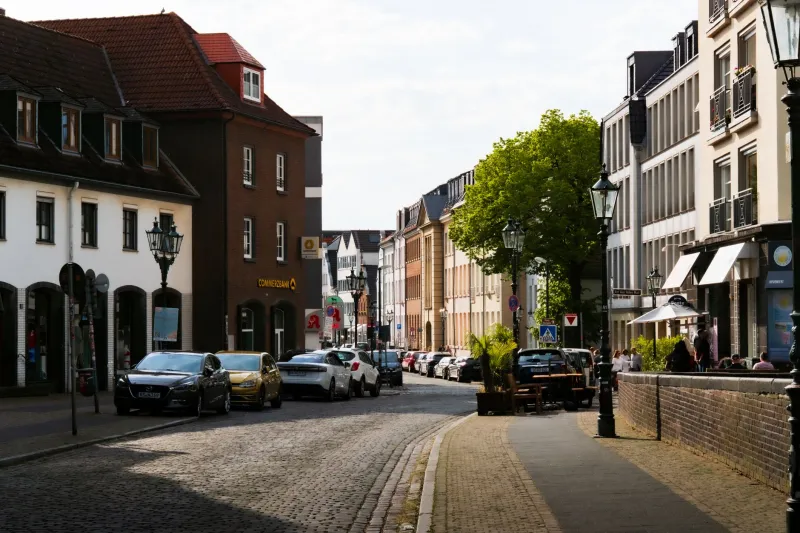
Not all neighborhoods support this kind of daily ritual equally. In car-dependent suburbs, dog walking often means a loop around the block on a street with no sidewalk, or a drive to a dog park five miles away. The spontaneous encounter — the one that turns into a friendship — rarely happens when the infrastructure doesn't support it.
Walkable communities with good design offer something different:
Sidewalks that actually go somewhere. This sounds obvious, but it isn't. Many suburban neighborhoods have sidewalks that dead-end, loop back on themselves, or connect to nothing interesting. A dog walk that takes you past a coffee shop, a green space, or a small plaza gives you a destination — and destinations mean encounters.
Off-leash areas and dog-friendly parks. There's a particular social alchemy that happens in an off-leash dog park. While the dogs sort out their own social hierarchy, the humans standing around the perimeter inevitably start talking. Dog parks are one of the few remaining public spaces where adults regularly interact with strangers without any particular agenda — and that's genuinely valuable.
Pet-friendly outdoor seating. More and more well-designed communities are embracing the European norm of allowing leashed dogs at outdoor café tables and restaurant patios. When that's an option, the dog walk becomes a social outing rather than just a chore. You linger. You order a second coffee. You end up in a conversation you didn't plan on having.
Safe, slow streets. A dog owner's relationship with their neighborhood is shaped enormously by how safe the streets feel. Wide, fast-moving roads aren't just unpleasant — they're genuinely dangerous for dogs and their owners. Neighborhoods with traffic calming, crosswalks, and pedestrian-first design make the daily walk a pleasure rather than a nerve-wracking exercise in survival.
The Data Behind the Dog-Friendly Neighborhood
The connection between pet-friendly design and community health goes deeper than casual observation. The American Veterinary Medical Association estimates that roughly 45% of U.S. households own at least one dog — making dog owners one of the largest demographic groups in any residential community.
When that many people have a daily reason to be outside and moving through their neighborhood, the ripple effects are significant. More foot traffic means more natural surveillance, which correlates with lower crime rates. More regular outdoor time means more incidental exercise, which has well-documented health benefits. And more neighbor-to-neighbor contact — even casual, sidewalk-level contact — correlates with higher reported wellbeing and lower rates of social isolation.
In short: design a neighborhood that works for dogs, and you've designed a neighborhood that works better for everyone.
What Happens When the Design Gets It Wrong
The contrast is stark in communities that don't get this right. Dog owners in car-dependent neighborhoods often describe their pets' exercise as a logistical problem to be solved — a drive to a park, a fenced backyard as a substitute for real walks — rather than a daily ritual woven into neighborhood life.
"We had a yard, so I figured that would be enough," says Marcus, who recently moved from a large suburban home to a walkable community with his golden retriever, Mango. "But she wasn't getting real exercise, and I definitely wasn't meeting anyone. Now we walk every morning and every evening, and I've met half the people in our block in the last two months. Mango is thriving. Honestly, so am I."
That's the thing about dogs: they're honest about what they need. Regular movement. Interesting smells. Other creatures to interact with. A neighborhood that delivers on those needs — through sidewalks, parks, safe streets, and a general culture of being outside — is a neighborhood that's doing something right.
The Unexpected ROI of a Dog-Friendly Community
When people evaluate a neighborhood, they think about school ratings, commute times, and price per square foot. They don't usually think about whether their dog will have a good life there.
Maybe they should. Because the features that make a neighborhood great for a dog — walkability, green space, slow streets, a culture of being outside — are almost exactly the features that make a neighborhood great for humans too.
Your dog isn't just a pet. In the right neighborhood, they're a social life waiting to happen. All they need is a place to walk to.