Beautiful Neighborhoods, Empty Lives: The Loneliness Nobody Talks About in 'Nice' Suburbs
Photo: 玄史生, CC0, via Wikimedia Commons
Rachel moved to a highly-rated suburb of Charlotte in 2019. Great schools, low crime, beautiful homes on large lots, friendly HOA. She checked every box on the conventional homebuyer checklist.
"I didn't know my neighbors for two years," she says. "Like, not even their names. I'd wave from the driveway. That was it. I thought I was just introverted. Eventually I realized — there was literally nowhere to accidentally meet anyone."
Rachel's experience is more common than the real estate brochures suggest. Across America, some of the most desirable zip codes — the ones with the best Zillow ratings and the most coveted school districts — are quietly producing some of the most isolated residents. The paradox of the "perfect" neighborhood is that its very design often works against the thing humans need most: each other.
The Loneliness Numbers Are Worse Than You Think
The U.S. Surgeon General's 2023 advisory on loneliness and isolation made headlines when it declared America in the grip of a loneliness epidemic. More than half of American adults report measurable loneliness. The health consequences are striking: chronic loneliness is associated with a 26% increased risk of premature death, comparable to smoking 15 cigarettes a day.
But here's what gets less attention: loneliness doesn't correlate neatly with poverty or density. It cuts across income levels, age groups, and geography. In fact, some research suggests that affluent suburban communities — the ones with the most physical space and the most privacy — can produce particularly acute social isolation, precisely because they were designed to maximize individual comfort rather than collective life.
Sociologist Robert Putnam documented this pattern in Bowling Alone, his landmark study of declining civic engagement. Car-dependent sprawl, he found, is among the strongest predictors of social disconnection. Every 10 additional minutes of commuting, Putnam calculated, reduces community involvement by 10%. The neighborhood you chose for its quiet and space may be the same neighborhood that's quietly hollowing out your social world.
What 'Nice' Gets Wrong
There's nothing wrong with wanting a beautiful home. But somewhere along the way, American real estate culture conflated aesthetic quality with community quality — and those are genuinely different things.
A well-maintained neighborhood can have pristine landscaping, high property values, and near-zero crime — and still produce profound isolation. Why? Because the physical design never creates conditions for connection.
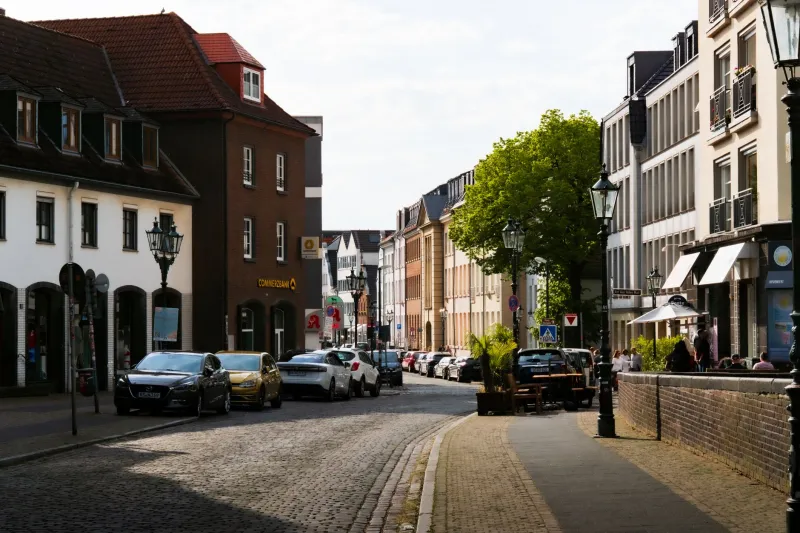
Think about what a typical upscale subdivision actually looks like from a social architecture standpoint. Homes set back from the street behind deep lawns and two-car garages. No sidewalks, or sidewalks that lead nowhere meaningful. No shared outdoor spaces beyond the occasional tot lot. No commercial life — no coffee shop, no corner market, nothing that draws people out of their homes and into contact with each other. Every trip requires a car. Every errand is a solo mission.
In this environment, you can live next to someone for a decade and never have a conversation that lasts more than 90 seconds. Not because you're unfriendly. Because the neighborhood never gave you a reason to stop.
The Design of Belonging
Contrast that with what urban planners and sociologists call "third places" — the spaces that aren't home and aren't work, where informal social life actually happens. The coffee shop. The village square. The community garden. The front stoop visible from the sidewalk.
Ray Oldenburg, the sociologist who coined the term, argued that third places are the foundation of community life. They're where friendships form, where neighbors become more than strangers, where the texture of local identity gets woven. And they don't happen by accident. They happen because the built environment makes them possible.
Walkable mixed-use communities are, at their core, third-place machines. When you build a neighborhood around human-scale streets, shared courtyards, ground-floor retail, and destinations within walking distance, you create the conditions for the casual, repeated, low-stakes interactions that researchers identify as the building blocks of genuine social connection.
You don't have to organize a block party. You just have to walk to get coffee.
Residents Describe the Difference
David and his husband relocated from a wealthy suburb outside Boston to a mixed-use village community in their mid-40s. The move was practical at first — shorter commute, walkable errands. The social dimension surprised them.
"Within three months, I knew more people by name than I had in eight years in our old neighborhood," David says. "Not because I'm more social now. Because there are places to be social. I see the same people at the farmers market, at the wine bar, walking their dogs. You don't have to try. It just happens."
That phrase — you don't have to try — comes up repeatedly among people who've made this kind of move. And it points to something important. Sustainable community isn't built through effort and programming. It's built through proximity and repetition. Through the daily accumulation of small, unremarkable encounters that, over time, become the fabric of belonging.
Forced community events — the HOA mixer, the neighborhood watch meeting — can supplement that fabric. They can't replace it. And in suburbs without the underlying design to support organic connection, no amount of scheduled socializing fills the gap.
Pretty Isn't the Same as Home
For Rachel, the realization came slowly. She started looking at other kinds of neighborhoods — not because she wanted to downgrade, but because she wanted something her current neighborhood couldn't give her.
"I wanted to feel like I lived somewhere," she says. "Not just that I owned a house somewhere."
She eventually moved to a walkable village community and describes the transition as disorienting in the best possible way. "The first time a neighbor knocked on my door just to say hi — not about a package, not about a noise complaint — I almost didn't know what to do. It felt weird. Then it felt like exactly what I'd been missing."
The loneliness epidemic in America's nicest neighborhoods isn't going to be solved by better programming or more motivated residents. It's going to be solved by building differently. By designing neighborhoods that put people in each other's paths — not by accident, but on purpose.
Because a beautiful neighborhood is worth something. But a neighborhood where you actually belong to something? That's worth everything.