How Your Street Layout Is Quietly Deciding Who Your Friends Will Be

There's a moment most people remember from their first few months in a new neighborhood. Maybe it was someone passing by while you were unpacking boxes. Maybe it was a chance run-in near the mailboxes, or a quick chat while your dogs sniffed each other on a shared path. It felt spontaneous. Natural. Almost lucky.
But here's the thing — it probably wasn't luck at all.
Researchers who study how communities form have spent decades documenting something that urban designers have quietly known for a long time: the physical layout of where you live has an enormous influence on who you end up knowing. The architecture isn't just background scenery. It's actively shaping your social life, one design choice at a time.
The Science Behind the Small Talk
Back in the late 1940s, MIT researchers Leon Festinger, Stanley Schachter, and Kurt Back conducted a now-famous study of housing at MIT called the Westgate Studies. They found that the single biggest predictor of friendship between residents wasn't shared interests, similar backgrounds, or even personality compatibility. It was physical proximity — specifically, whether people's paths naturally crossed during daily routines.
Residents who lived near stairwells, mailboxes, or communal entrances ended up with significantly larger social networks than those tucked away in quieter corners. The people who became friends weren't necessarily seeking each other out. The building's design was creating the conditions for connection, almost automatically.
Decades later, that research holds up remarkably well. A 2019 study published in Environment and Behavior found similar patterns in modern residential communities — neighborhoods with shared outdoor spaces, mixed-use ground floors, and pedestrian-friendly layouts produced measurably stronger social ties among residents. The architecture, in effect, was doing the introductions.
Courtyards: The Original Social Algorithm
If you've ever visited a well-designed mixed-use neighborhood and noticed how alive the courtyards feel — kids playing, neighbors chatting, someone's dog making the rounds — that's not accidental. Shared courtyards are one of the oldest tricks in the community design playbook, and they still work.
The reason is pretty straightforward. When a courtyard sits at the center of a cluster of homes, it becomes what designers call a "third place" — somewhere that isn't quite home, but isn't quite public either. It's a low-stakes environment where you can be social without committing to a whole dinner party. You can step out for five minutes, bump into a neighbor, and head back inside. That kind of casual, repeated contact is exactly how friendships form.
Compare that to a neighborhood where every home faces a private garage and the front yard is mostly decorative. Those residents might live twenty feet from each other for years and never learn each other's names. The design isn't hostile to connection — it's just indifferent to it. And indifference, it turns out, is enough to prevent community from forming organically.
Pathways That Do the Work For You
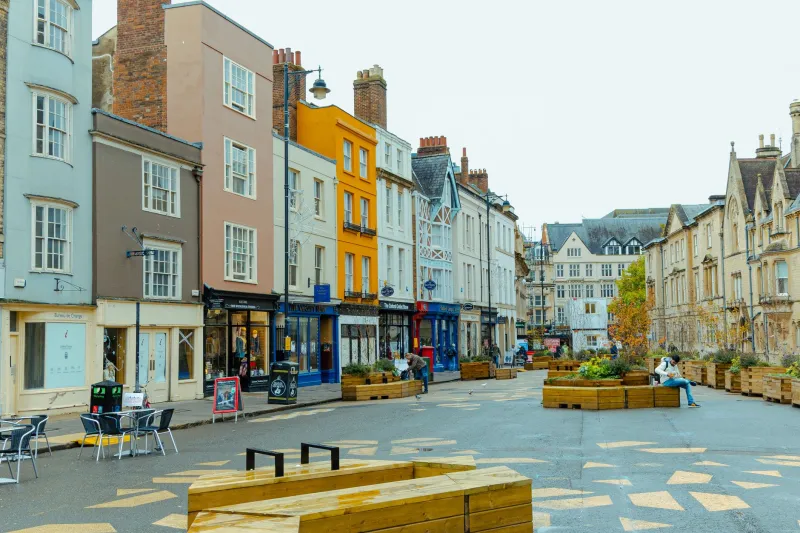
One of the subtler design tools that smart developers use is what you might call strategic routing — placing pedestrian pathways in ways that gently funnel foot traffic through shared spaces rather than around them.
Think about the difference between a neighborhood where every resident drives in, parks, and enters through a private side door versus one where the natural walking route from the parking area passes through a small plaza, a pocket park, or a row of shops and benches. In the second scenario, you're going to see familiar faces on a Tuesday afternoon whether you planned to or not. Over time, those faces become names. Names become conversations. Conversations become the kind of relationships that make a place feel like home rather than just a house.
At Front Street Village, this idea isn't theoretical — it's baked into how the community is laid out. The pathways, the gathering nodes, the way foot traffic naturally flows through shared spaces rather than bypassing them — all of it reflects an understanding that connection doesn't happen by accident. It happens because someone designed the conditions for it.
Why Developers Who Get This Build Better Places
Not every real estate developer thinks this way, and it shows. There's a version of neighborhood-building that treats community as a marketing bullet point — slap a clubhouse on the amenities list, call it done. But residents in those places often describe a strange loneliness. The infrastructure for socializing exists, but the day-to-day design doesn't nudge people toward actually using it.
The developers who build genuinely strong communities tend to ask a different set of questions during the planning phase. Not just where will people live, but where will people naturally congregate? Not just what amenities do we offer, but which spaces will generate repeated, low-pressure encounters between neighbors?
That distinction — between amenities that exist and spaces that actually function — is often the gap between a neighborhood that feels alive and one that feels like a collection of units.
What to Look For When You're Shopping
If you're in the market for a new home and community connection matters to you, it's worth paying attention to a few specific design signals:
- Front porches and stoops that face shared walkways — not driveways. Homes oriented toward pedestrian activity invite casual interaction in a way that garage-facing facades simply don't.
- Shared green spaces positioned between homes, not just at the edges of the development. Central placement means residents pass through them, not past them.
- Mixed-use ground floors or nearby retail — coffee shops, small markets, and services that give residents a reason to be out and moving around on foot, where they'll inevitably run into people they recognize.
- Benches, shade, and places to pause — the small stuff matters. A pathway with nowhere to stop is just a route. A pathway with a shaded bench becomes a place where someone might actually slow down long enough to have a conversation.
The Neighborhood Is the Product
Real estate is usually marketed around the home itself — the square footage, the finishes, the school district. And those things matter. But for a lot of people, especially those who've lived in places that felt isolated despite being densely populated, what they're really searching for is a sense of belonging.
The good news is that belonging isn't entirely up to chance or personality. It's partly a design problem, and design problems have solutions. When a neighborhood is built with human connection in mind — when the courtyards, the pathways, the gathering spaces are all working together to create natural moments of contact — community tends to follow.
Your future best friend might already be living twenty feet away. The real question is whether your neighborhood is designed to introduce you.