Let Them Play: What Happens to Kids When Their Neighborhood Becomes Their World
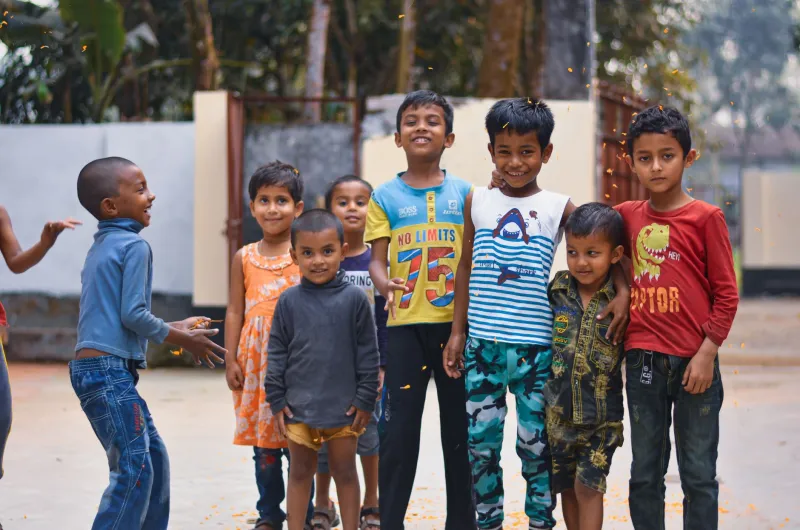
Remember When the Street Was the Playground?
There's a particular kind of childhood memory that keeps showing up in conversations about what people wish they could give their kids. It usually involves a bike, a loose group of neighborhood children, and no specific plan for the afternoon. Nobody's parent organized it. Nobody set a timer. It just... happened.
For a lot of American families today, that version of childhood feels like a historical artifact — something that belonged to a different era, a different country, or a different kind of neighborhood. And honestly? That loss is doing real damage.
The research on unstructured outdoor play has been quietly piling up for years, and the picture it paints is striking. Kids who spend regular time playing outside — especially in mixed-age groups, in shared community spaces — show measurably lower rates of anxiety, better emotional regulation, stronger social skills, and greater resilience when things get hard. Pediatricians and child psychologists aren't just nodding along to this data. Many of them are now calling the decline of outdoor neighborhood play a genuine public health issue.
But here's the thing most of those conversations miss: this isn't really about screen time. It's about place.
It's Not Just About Being Outside — It's About Being Together Outside
There's a meaningful difference between a kid who plays in a fenced backyard and a kid who wanders over to a shared green space and ends up in an impromptu game with a seven-year-old, a ten-year-old, and a couple of teenagers who half-heartedly supervise. Both kids are getting fresh air. Only one of them is getting something that actually shapes who they become.
Researchers who study child development call this kind of environment a "loose parts" social setting — unscripted, unstructured, and full of the kind of low-stakes friction that teaches kids how to negotiate, compromise, read social cues, and recover from disappointment. You can't replicate it in a scheduled playdate. You definitely can't replicate it on a screen.
The mixed-age piece is particularly important and often overlooked. When younger kids play alongside older ones, they're exposed to more complex language, more sophisticated problem-solving, and natural mentorship. Older kids, meanwhile, develop patience, leadership, and empathy in ways that peer-only environments rarely produce. These interactions used to happen organically in neighborhoods where kids of different ages all had access to the same sidewalks, parks, and open spaces. In communities where that physical infrastructure exists — where there's actually somewhere to go and something to do when you step outside — those interactions still happen.
The Anxiety Connection Nobody's Talking About
Childhood anxiety has risen sharply over the past two decades. The causes are complicated, and researchers debate the relative weight of different factors. But one thread that keeps appearing in the literature is the role of what's sometimes called "free range" experience — the opportunity for children to navigate real environments, face real (but manageable) challenges, and develop what psychologists call self-efficacy.
Self-efficacy, simply put, is the belief that you can handle things. That when something goes wrong, you'll figure it out. Kids who spend time in unstructured outdoor play develop this almost as a side effect — they fall off bikes, they lose arguments, they get rained on, they find their way home. Each of those small experiences is a deposit in an internal bank account that pays out as resilience later.
Kids who spend their childhoods largely indoors, in structured activities, or in supervised environments where adults smooth over every conflict and manage every outcome — those kids often arrive at adolescence with an underdeveloped capacity to cope. Not because their parents did anything wrong. Because the environment didn't give them the raw material.
What This Has to Do With Where You Live
Here's the uncomfortable truth that a lot of real estate conversations dance around: the physical design of your neighborhood determines whether any of this is even possible.
If the nearest park requires a car ride, kids don't go spontaneously. If there's no safe walking path between houses, kids don't wander over. If the only shared outdoor space is a strip of grass between parking lots, kids don't linger. The architecture of a neighborhood either enables this kind of childhood or it doesn't — and for decades, a lot of American suburban development has quietly made it harder.
Village-style communities designed around walkability, shared green space, and human-scale streets change that equation. When a park is visible from the front door, kids go. When neighbors share a courtyard or a common lawn, kids find each other. When streets are designed for people instead of just cars, the neighborhood itself becomes a place worth inhabiting.
At Front Street Village, this isn't an accident or a marketing point — it's a design philosophy. The idea that community happens in the spaces between homes, not just inside them, shapes how the whole place is built. Parks and gathering areas aren't afterthoughts tucked at the edge of the development. They're central. They're connected. They're the kind of places kids actually want to be.
What Parents Can Actually Do
If you're raising kids and this is landing somewhere real for you, the good news is that you don't need a parenting overhaul. You need a neighborhood that does some of the work.
A few practical things worth thinking about:
Look for density of kids, not just amenities. A beautiful park that's always empty doesn't help. A modest green space where neighborhood kids naturally gather does. Ask about the age demographics of the community before you buy.
Prioritize walkable access over square footage. A slightly smaller home in a neighborhood where kids can actually get places on their own is often the better trade for families with children. The independence that comes from being able to walk to a friend's house or a corner store is developmentally significant.
Notice the street design. Wide, fast streets discourage outdoor play. Narrow, slower streets with sidewalks encourage it. This sounds small. It isn't.
Think about who your neighbors will be. Multi-generational communities — places where young families, older couples, and everyone in between share the same streets — tend to produce the kind of mixed-age play environments that benefit kids most.
The Neighborhood Is the Toy
Parents spend a lot of energy thinking about what to give their kids — the right school, the right activities, the right devices (or not), the right experiences. All of that matters. But the neighborhood itself is a kind of infrastructure for childhood, and it's one that most families don't evaluate nearly carefully enough when they're choosing where to live.
The playground effect is real. Kids who play outside together — in neighborhoods designed to make that easy and natural — come out ahead on almost every measure of mental health and social development that researchers track. That's not a small thing. That's the whole thing.
Where you live is shaping your kids whether you've thought about it that way or not. The question is just whether you're making that choice consciously.