Your Kid Can't Walk to a Friend's House. That's Not Normal — It's a Design Flaw.

Photo: Post of Finland, Public domain, via Wikimedia Commons
It's 10 a.m. on a Wednesday in July. School's been out for three weeks. Somewhere across America, a child is standing at a window, restless, while their parent scrolls through options: swim lessons, a day camp, a drop-in pottery class, maybe just another hour of screen time before guilt kicks in.
"He's bored," says Trish, a mom of two in a mixed-use village community in the mid-Atlantic. "But like, productively bored. He wanders down to the green and finds kids. They make something up. I don't have to do anything."
That small sentence — I don't have to do anything — is quietly revolutionary. For a generation of suburban parents who've essentially become unpaid chauffeurs for their children's social lives, the idea that a kid can simply go find friends without a scheduled playdate, a car ride, and a confirmed parental pickup time feels almost radical.
It shouldn't. It used to just be called childhood.
The Accidental Isolation of Suburban Design
Traditional suburban neighborhoods weren't designed with malice. They were designed for cars, for privacy, for the postwar American ideal of space and separation. What nobody fully anticipated was the downstream effect on children: a geography so spread out, so car-dependent, and so lacking in shared public space that kids can't get anywhere on their own.
Jonathan Haidt and Greg Lukianoff, in their widely discussed book The Coddling of the American Mind, point to the dramatic decline in unsupervised outdoor play since the 1980s as a significant contributor to rising anxiety and social fragility in young people. But they're careful to note that this isn't simply a parenting problem. It's an environment problem.
Kids in cul-de-sac subdivisions face a specific set of obstacles. There's nowhere to walk to. Streets are designed for through-traffic, not foot traffic. There are no corner stores, no village greens, no natural gathering points. Even if a friend lives three streets over, getting there requires crossing a multi-lane collector road with no sidewalk. So parents drive. Or kids stay home. Over time, the expectation of independence never really forms.
Psychologist Peter Gray, who has spent decades researching children's play, argues that the loss of free-range neighborhood time has directly stunted kids' ability to manage risk, resolve conflict, and build genuine friendships. "Play is how children learn to be human," he writes. "And we've designed that out of their daily lives."
What Happens When the Neighborhood Actually Works
Parents who've moved to walkable, mixed-use communities describe a shift that catches them off guard.
Kevin and Simone moved with their two daughters — ages 8 and 11 — to a village-style community two years ago. Within a month, something changed.
"Our older one started just... leaving," Simone says, laughing. "Like, after breakfast she'd say 'I'm going to find Emma' and just go. I had to remind myself that was okay. That was the whole point."
What their daughter found wasn't a scheduled activity. It was the coffee shop on the corner where the owner knows her name, the little plaza where kids congregate after school, and the Saturday farmers market that she and a friend started biking to on their own. None of it was organized. All of it was formative.
"She's more confident than I was at her age," Simone says. "She can navigate. She can talk to adults. She can handle herself. And I think a huge part of that is just — she's been allowed to move through the world."
Researchers call this "environmental affordance" — the degree to which a physical space enables or restricts certain behaviors. Neighborhoods with high walkability, visible street life, mixed uses, and human-scale design naturally afford children more independence. The design does the work that no amount of parenting advice can replicate.
Organized Activities Are Great. They're Also Not Enough.
To be clear: summer camps, sports leagues, and enrichment programs have real value. They teach skills, build discipline, and create friendships. Nobody's arguing against them.
But they're not a substitute for unstructured time in a neighborhood that kids can actually move through freely. Developmental psychologists draw a consistent distinction between adult-organized activities and child-directed play — and the research strongly suggests that children need both, not just one.
When every social interaction requires parental logistics — a text to another parent, a calendar check, a 20-minute round trip — the bar for spontaneous connection becomes too high. Kids stop trying. They default to screens not because screens are more appealing, but because screens are available in a way that friends, by suburban design, often aren't.
The neighborhood boredom so many parents dread isn't a failure of imagination. It's a failure of infrastructure.
The Village Difference
What makes a walkable mixed-use community different isn't just the presence of sidewalks (though those help). It's the density of destinations, the visibility of public life, and the layering of ages and activities that creates a kind of ambient social energy.
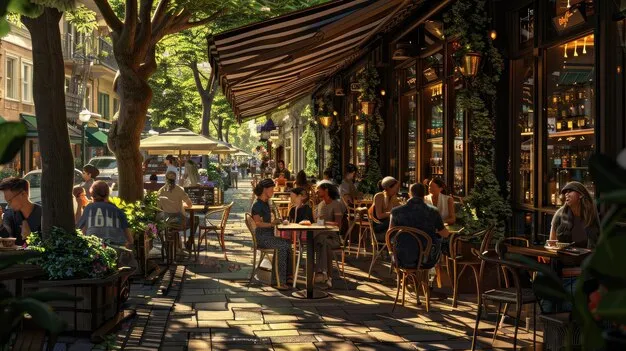
When a child can walk to a coffee shop, a small park, a corner market, and a neighbor's front porch — all within a few safe, human-scale blocks — the neighborhood becomes a world. A manageable, explorable, confidence-building world.
That's not nostalgia. That's design.
For parents exhausted by the logistics of suburban childhood, and for kids who deserve more than a screen and a waiting list for soccer camp, the question isn't really about activities at all. It's about the kind of place you're raising them in.
Because the best summer your kid ever has probably doesn't start with a registration form. It starts with a front door they're allowed to walk out of on their own.