What Your Neighborhood Sounds Like Might Be Slowly Changing Your Mind
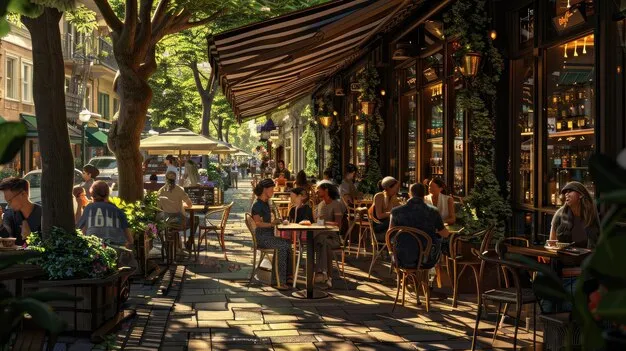
Photo: peaceful walkable neighborhood street with people walking outdoor cafe sounds community life, via img.freepik.com
Close your eyes for a second and listen to whatever's outside your window right now.
Is it the low rumble of traffic on a six-lane road? The intermittent blast of a car horn? The mechanical drone of an HVAC unit on a strip mall? Or is it something else — kids calling out to each other down the block, the murmur of a patio conversation, maybe a dog barking once before going quiet?
Those sounds feel like background noise. But your brain is treating them like information. And depending on what it's hearing, it may be slowly working against you.
Your Brain Never Really Stops Listening
Here's something that might surprise you: even when you're asleep, your auditory system stays partially active. It's an evolutionary holdover — your ancestors needed to hear threats in the dark. The problem is your nervous system hasn't caught up with the modern soundscape, which means it can't always tell the difference between a predator and a garbage truck at 5 a.m.
Researchers at the World Health Organization have been studying what they call "environmental noise pollution" for decades, and the findings aren't subtle. Chronic exposure to traffic noise — specifically the unpredictable, high-decibel kind common in car-dependent neighborhoods — has been linked to elevated cortisol levels, disrupted sleep architecture, increased risk of anxiety disorders, and even cardiovascular issues. The mechanism is pretty straightforward: noise triggers your stress response. Do it often enough, and your baseline stress level simply rises.
A 2018 study published in Environmental Health Perspectives found that people living in high-traffic noise zones reported significantly worse mental health outcomes than those in quieter areas — even after controlling for income, age, and other factors. The noise itself was doing damage.
Not All Noise Is Created Equal
Here's where it gets interesting, though. The research doesn't suggest that silence is the goal. In fact, complete acoustic isolation — think of those eerily quiet cul-de-sacs where you never hear another human being — has its own set of psychological downsides. Loneliness and social disconnection are among the most well-documented mental health risks of our time.
What the science actually points to is something more nuanced: the type of sound matters as much as the volume.
Researchers have identified a distinction between what they call "signal noise" — sound that carries meaningful social or environmental information — and "stress noise," which is essentially acoustic chaos with no useful content. The distant sound of children playing registers in the brain differently than the sound of a car accelerating past your bedroom window at midnight. One signals safety, activity, and community. The other signals danger, or at least unpredictability.
Nature sounds, human conversation at a comfortable distance, the ambient activity of a place that's alive but not frantic — these have been shown in multiple studies to actually reduce cortisol and promote psychological restoration. There's a reason people pay for sound machines that play rain or a babbling brook. Your nervous system finds those sounds inherently reassuring.
The Acoustic Difference in How Places Are Built
This is where neighborhood design stops being an abstract planning conversation and starts being deeply personal.
Most American suburbs were designed around the car. That means wide arterial roads, high traffic speeds, and residential streets that function as connectors between driveways rather than places where life actually happens. The acoustic result is a soundscape dominated by engines, tires on asphalt, and the particular whine of vehicles traveling at speed. It's not that the neighborhood is loud all the time — it's that when it is loud, the sound is abrupt, high-intensity, and unpredictable. That's exactly the kind of noise profile that keeps stress hormones elevated.
Mixed-use village designs work differently, and part of the reason has nothing to do with intention — it's a byproduct of how the streets function. When traffic is naturally calmed by shorter blocks, on-street parking, and street trees, vehicles slow down. Slower vehicles are dramatically quieter. When retail and residential uses are interspersed, people walk. Foot traffic generates a softer, more human-scaled acoustic environment. When buildings are placed closer to the street with active storefronts, they actually act as acoustic buffers for the residential spaces behind them.
Some newer developments are now incorporating intentional acoustic planning — considering things like the placement of open green space to absorb sound, the orientation of residential windows relative to traffic corridors, and the use of landscaping as a natural sound barrier. These aren't expensive or exotic features. They're just design decisions made with the full human experience in mind, not just the visual or square footage checklist.
The Sound of a Place That's Actually Alive
There's something worth sitting with here, beyond the research. A neighborhood that sounds like people are living in it — genuinely, actively, comfortably — is a neighborhood where people want to be outside. And people who spend more time outside their homes, in incidental contact with their neighbors, are consistently shown to be happier, healthier, and more resilient.
The sounds of community aren't just pleasant. They're a feedback loop. You hear activity, you're drawn outside, you become part of the activity, someone else hears it and comes out too. The acoustic environment of a walkable village isn't just a side effect of good design. In a real way, it is the community signaling to its residents: this is a place where you belong.
Contrast that with the ambient message of a car-dependent neighborhood at 7 p.m. on a Tuesday: total silence broken only by the sound of garage doors closing. That's not peaceful. That's isolation with a soundtrack.
What to Actually Listen For When You're House Hunting
Next time you're touring a home or exploring a neighborhood, try this: stand still for two minutes and just listen.
Are you hearing mostly engines and mechanical noise, or are you hearing human activity? Is the sound environment unpredictable and high-intensity, or is it layered and relatively consistent? Can you hear other people living their lives nearby, or does the neighborhood feel acoustically sealed off?
Those questions sound simple. But the answers might tell you more about your future quality of life than the kitchen finishes or the square footage of the primary bedroom.
Where you live is a sensory environment, not just a physical address. And your brain — whether you ask it to or not — is going to respond to every single sound it hears. Choosing a neighborhood that sounds like life is actually happening there isn't a luxury preference. Increasingly, the research suggests it might be one of the better investments in your own mental health you can make.