Home Is Actually Cool Now: What Good Neighborhood Design Does for Your Teenager
Ask any parent of a teenager what their kid's ideal Friday night looks like, and the answer is usually some variation of "anywhere but here." The pull toward elsewhere — toward the mall, toward a friend's house across town, toward literally any space that isn't the family home — is practically a rite of passage in American adolescence.
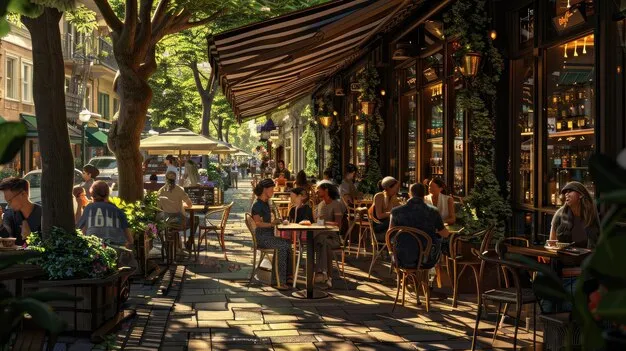
But spend time in communities where the neighborhood itself has been thoughtfully designed, and you start to notice something unexpected. The teenagers are still around. Not because they're grounded. Not because they're glued to their phones. They're outside, they're at the coffee shop on the corner, they're hanging out on the plaza near the fountain, they're running into each other organically in the spaces between home and wherever else.
This isn't magic. It's design.
What Teenagers Actually Need (That Most Suburbs Don't Provide)
Adolescent development research is pretty clear on one thing: teenagers need social space that belongs to them, but that exists within a safe, community context. They're at a stage where independence matters enormously — the ability to move through the world on their own terms, make decisions, navigate social dynamics without a parent hovering nearby. But they also need proximity. Connection. The comfort of knowing familiar faces are close.
The problem with most traditional suburban layouts is that they offer neither. The spaces available to teens are almost entirely adult-controlled (home, school, organized activities) or require a car to reach (the movie theater, the food court, the bowling alley twenty minutes away). There's almost no in-between.
Psychologist Dr. Peter Gray, whose work on adolescent autonomy has been widely cited in developmental circles, has argued that the erosion of unsupervised, child-directed social time is one of the defining challenges of modern American childhood. Kids — and especially teenagers — need to practice being independent. They need spaces where they can do that.
Walkable, mixed-use communities create exactly that kind of space.
The Corner Store as Social Infrastructure
It sounds almost too simple. But talk to teenagers who live in communities with genuine walkable amenities, and a pattern emerges quickly.
Jada, 16, lives in a mixed-use neighborhood with a coffee shop, a small bookstore, and a handful of independent restaurants all within a ten-minute walk of her front door. "I go to the coffee place pretty much every day after school," she says. "I run into people I know, sometimes people I don't know yet. It's just somewhere to be that isn't home and isn't school."
That "somewhere to be" is doing more developmental work than it might appear. Social researchers call these spaces "third places" — not home, not school or work, but the informal public gathering spots that stitch communities together. For adults, third places might be a local bar, a gym, a church. For teenagers, the options are often painfully limited in car-dependent suburbs.
In walkable village settings, third places exist at a scale and accessibility that teenagers can actually use — on foot, independently, without coordinating a ride.
Marcus, 17, puts it plainly: "In my old neighborhood, you had to get driven everywhere. It felt like you were always waiting on someone. Here, I can just go. That's a big deal when you're 16 and can't drive yet."
The Psychology of Staying Local
There's a well-documented phenomenon in environmental psychology sometimes called "place attachment" — the emotional bond people form with specific physical spaces. Research consistently shows that strong place attachment in adolescence correlates with better mental health outcomes, stronger community ties, and even higher civic engagement in adulthood.
But place attachment doesn't develop in a vacuum. It develops through repeated, meaningful experience in a place. And that requires places worth experiencing.
When a neighborhood has genuine character — interesting architecture, varied uses, the sounds and smells of active street life — teenagers engage with it differently than they do with a cul-de-sac surrounded by garage doors. There's something to notice, something to explore, something to return to.
Parents in mixed-use communities often describe a shift they didn't fully anticipate: their teenagers start becoming advocates for the neighborhood. They have favorite spots. They have opinions about the new restaurant that opened up. They know the name of the guy who runs the bookstore.
That's not a small thing. That's a teenager developing an identity that's rooted in community rather than defined entirely by digital spaces.
What This Means for Family Dynamics
Here's the part that surprises parents most: when teenagers have good reasons to stay local, they actually come home more. Not because they have to — because the neighborhood and the home are connected in a way that makes both feel like part of the same continuous social world.
Kids who walk home through a neighborhood they like, who stop and chat with familiar faces along the way, who arrive back in a good mood because they've had an actual social afternoon — those kids tend to be more present at dinner, more willing to talk about their day, more engaged with family life overall.
The design of the neighborhood, it turns out, has a direct line to the quality of what happens inside the house.
Building Communities Where Teenagers Choose to Belong
At Front Street Village, the question of how the neighborhood serves its younger residents isn't an afterthought — it's baked into the planning from the start. Gathering spaces sized for informal hangouts. Walking routes that feel active and interesting. Mixed uses that give teenagers real reasons to move through the community on their own terms.
The goal isn't to trap teenagers in the neighborhood. It's to make the neighborhood good enough that choosing to stay feels like a genuine option — maybe even a preference.
That's a different kind of community. And increasingly, it's the kind teenagers are actually asking for.