How Close Is Close Enough? Rethinking Real Estate Around the People Who Matter Most

When most people sit down to make their homebuying checklist, it looks pretty predictable. Bedrooms, bathrooms, school district, commute. Maybe a yard. Maybe a garage. What almost never makes the list? How long it takes grandma to get to your front door.
That oversight might be costing families more than they realize.
There's a growing body of research — and honestly, a lot of common sense — pointing to extended family proximity as one of the most meaningful factors in how well a household actually functions. Not just emotionally, but practically. Financially. Even in terms of the health and development of your kids.
So why isn't it showing up on anyone's checklist?
The Nuclear Family Myth We've Built Our Suburbs Around
American suburban development in the second half of the 20th century was largely designed around one thing: the nuclear family. Mom, dad, kids, two-car garage, cul-de-sac. The assumption baked into that model was that the household was self-contained — that you didn't really need anyone nearby to make it work.
But that assumption has always been a little shaky, and in recent decades it's become harder to ignore how much strain it puts on families.
Think about it. When your parents live forty-five minutes away in a different suburb — or across the country entirely — every interaction requires a calendar event. Spontaneous visits don't happen. Grandparents can't just pop over to pick up the kids when your meeting runs late. Family dinners become logistical operations instead of casual Tuesday nights.
The distance doesn't just make things inconvenient. It quietly erodes the texture of everyday family life.
What the Research Actually Shows
Studies on child development have consistently found that children with active, involved grandparents show stronger emotional resilience, better social skills, and even improved academic outcomes. One longitudinal study out of Oxford found that close grandparent-grandchild relationships were associated with fewer behavioral and emotional problems in kids — effects that held even when controlling for other family variables.
For grandparents themselves, the benefits run in the other direction. Seniors who have regular, meaningful contact with grandchildren report higher levels of life satisfaction and lower rates of depression. Engagement with younger generations has even been linked to cognitive longevity. It turns out that being needed — really needed, in the daily fabric of family life — is protective in ways that scheduled visits simply can't replicate.
And for the parents sandwiched in the middle? The practical support that comes from having family nearby is enormous. Childcare costs in the United States have become staggering. When a grandparent can step in for a few hours a week — not as a full-time arrangement, but just as a natural part of being nearby — it changes the math of family life significantly.
The Design Problem Nobody's Talking About
Here's where neighborhood design enters the picture in a way that doesn't get nearly enough attention.
Sprawling suburban development doesn't just separate families geographically. It makes proximity functionally useless even when it technically exists. If your parents live two miles away but there's no sidewalk between your houses, no coffee shop to meet at, no park where the grandkids can run around while the adults catch up — then two miles might as well be twenty.
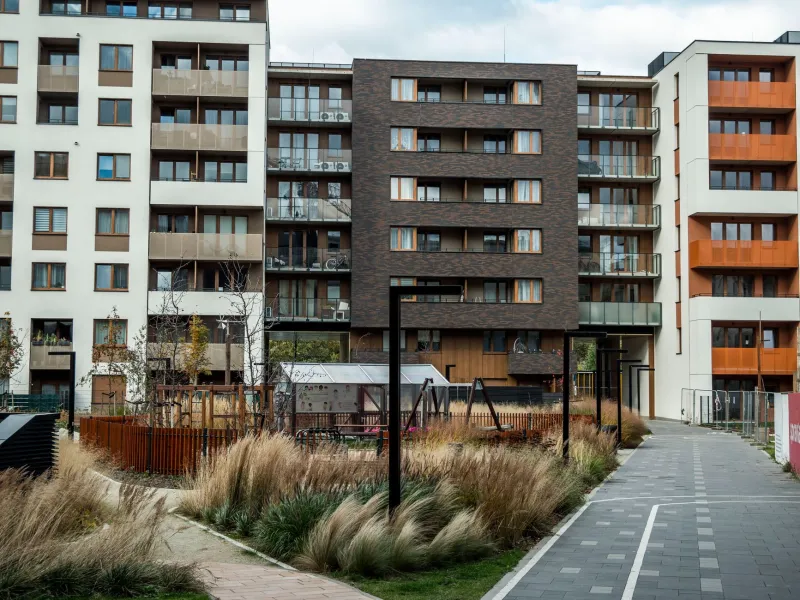
Contrast that with a walkable, mixed-use community where streets are designed for people, not just cars. Where there's a bench outside the bakery and a community green that everyone passes through. Where the distance between households is measured in minutes on foot rather than minutes in traffic.
In that kind of environment, proximity actually functions. Grandparents can walk over. Kids can ride bikes to grandma's. Families can run into each other at the farmers market without anyone having to plan it. The built environment either enables those connections or quietly kills them — and most suburban layouts are doing the killing.
The 'Grandparent Test' as a Real Estate Framework
So here's a practical reframe for your next home search: run the grandparent test.
The test is simple. If your parents or in-laws (or whoever fills that role in your family) wanted to live nearby — not necessarily next door, but within genuine visiting distance — could the neighborhood actually support that? Not just in terms of available housing, but in terms of how the place is designed?
Can two households stay connected without a car being involved every single time? Is there a place to meet that isn't someone's living room? Are there sidewalks? Is it easy to get from point A to point B without a production?
If the answer is mostly no, you might be buying into a neighborhood that structurally isolates generations from each other — regardless of how close the houses are on a map.
Multi-Generational Living Is Already on the Rise
It's worth noting that the cultural tide is already shifting. Multi-generational living arrangements have increased significantly over the past two decades. According to Pew Research, roughly 60 million Americans now live in multi-generational households — a figure that's nearly doubled since the 1970s. The trend is driven by everything from housing costs to immigration patterns to a growing recognition that the isolated nuclear family model just doesn't work as well as advertised.
But multi-generational living doesn't have to mean everyone under the same roof. For many families, the sweet spot is something closer to what sociologists call "intimacy at a distance" — close enough for genuine daily connection, far enough for everyone to have their own space and autonomy.
Walkable village communities are particularly well-suited to this model. When a neighborhood has a mix of housing types — smaller cottages alongside larger family homes, accessory dwelling units, apartments above retail — it creates natural opportunities for extended families to live near each other without living on top of each other.
What to Look For When You're House Hunting
If you're sold on the idea of building your home search around extended family connection, here are a few practical things to look for:
Housing variety. Does the neighborhood offer different sizes and price points? That matters if you want family members at different life stages to be able to afford to live nearby.
Walkable infrastructure. Sidewalks, crosswalks, low-speed streets. The physical stuff that makes it possible to move between households without getting in a car.
Gathering places. Parks, coffee shops, community spaces. The spots where spontaneous connection actually happens.
Mixed-use zoning. Neighborhoods that blend residential with retail and community uses tend to have more street life, which means more natural opportunities for people to run into each other.
Front Street Village was designed with exactly this kind of layered community life in mind. The idea isn't just to sell homes — it's to create a place where people can build a life that includes the people they love, without heroic logistical effort.
The Real Metric You've Been Missing
Here's the honest truth: square footage doesn't love your kids back. A great school district is valuable, but it doesn't pick them up when you're stuck in a meeting. The neighborhood amenities that make the biggest difference in daily life aren't always the ones in the listing photos.
Sometimes the most important feature of a home is whether the people who matter most to your family can actually be part of your everyday life there.
Run the grandparent test. You might be surprised what it tells you.