Your Neighbors Are Your Customer Base: How Village Communities Are Quietly Launching Businesses
Photo: Babewyn, CC BY-SA 4.0, via Wikimedia Commons
Nobody designed Front Street Village as a business incubator. The goal was to build a great place to live — walkable streets, mixed-use retail, genuine community gathering spaces, the kind of neighborhood where people actually know each other. But something interesting has been happening as a byproduct of all that intentional design: people are starting businesses here, and a surprising number of them are thriving.
It's not a coincidence. The same conditions that make a walkable village community a great place to raise a family also turn out to be remarkably fertile ground for entrepreneurship. And the story of why is worth understanding.
The Network You Didn't Know You Were Building
In a conventional suburban neighborhood, your social world and your professional world rarely overlap. You might know your neighbors well enough to wave, but the odds that any of them become clients, collaborators, or connectors for your business are pretty low. The geography works against it — everyone drives in from different directions, shops at different strip malls, and doesn't really share a common commercial ecosystem.
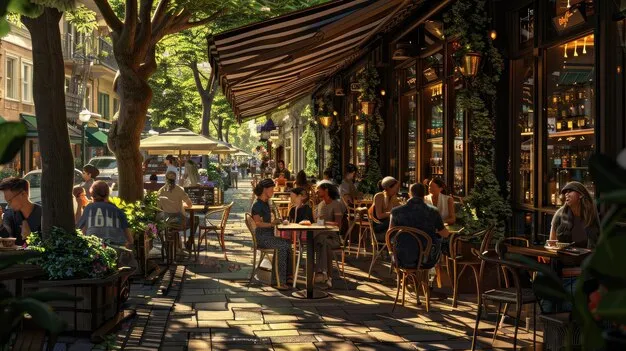
In a dense, walkable community, something different happens. You see the same people repeatedly — at the coffee shop, on the trail, at the farmers market, during the kind of low-stakes daily encounters that slowly build genuine familiarity. That familiarity becomes trust. And trust, in business, is worth more than almost any marketing budget.
Entrepreneurs who live in village-style communities consistently describe a version of the same experience: their first customers were neighbors. Not because they aggressively pitched anyone, but because people who know you and like you tend to want to support what you're building.
The Density Dividend
There's a straightforward economic argument here that doesn't require any romanticism about community spirit. In a walkable, higher-density neighborhood, a small business has access to a concentrated customer base within a short radius. A home-based service provider — a personal trainer, a bookkeeper, a graphic designer, a caterer — can realistically reach dozens or hundreds of potential clients without leaving their zip code.
In a sprawling suburb, that same provider might be technically accessible to the same number of people, but the friction of distance means most of those potential clients will never encounter them organically. Discovery happens through algorithms and advertising. In a village, it happens through conversation.
That distinction matters enormously for early-stage businesses. The biggest challenge most new ventures face isn't the product or the service — it's getting the first ten customers. In a connected community, that first ten is often right outside your front door.
The Businesses That Are Emerging
The range of businesses taking root in village communities is genuinely diverse, and it reflects the texture of the communities themselves.
Personal services — fitness coaching, tutoring, pet care, alterations, meal prep — thrive because they're relationship-dependent and because the demand within a community of families and professionals is consistent and recurring.
Artisan and craft businesses have found that local communities provide both a customer base and a reputation engine. A ceramicist, a woodworker, a candle maker with a studio in their garage can build a real local following through farmers markets and word of mouth in a way that's much harder to replicate through Etsy alone.
Consulting and freelance services — design, writing, marketing, accounting, coaching — benefit from the informal networking that dense communities naturally generate. When someone at a neighborhood gathering asks what you do and you can describe a specific, valuable service, you're in a sales conversation without ever having made a cold call.
Food and hospitality micro-ventures — pop-up dinners, cottage bakeries, specialty preserves, catering for neighborhood events — have found village communities to be remarkably receptive markets. People who care about community tend to care about local food, and they're willing to pay for quality from someone they trust.
The Built-In Loyalty Factor
One of the underappreciated advantages of building a business within a community you actually live in is the loyalty dynamic it creates. When your customers are also your neighbors, the relationship has a social dimension that pure commercial transactions lack.
People who buy from a neighbor aren't just making a purchasing decision. They're participating in the community's economic ecosystem. They're supporting someone they see at school pickup. They're contributing to the kind of local economic vitality that makes a neighborhood feel alive rather than just residential.
That loyalty tends to be stickier than the loyalty earned through discounts or rewards programs. It's personal. And it generates referrals at a rate that's hard to manufacture artificially.
What the Community Infrastructure Enables
It's worth noting that this entrepreneurial energy doesn't emerge in a vacuum. It's enabled by the specific design features of well-built communities.
Walkable streets mean residents are out and visible, which creates organic discovery opportunities for local businesses. Mixed-use zoning means there are legitimate commercial spaces available for small ventures that need a physical footprint. Community events — farmers markets, seasonal festivals, neighborhood gatherings — create regular venues for small businesses to reach concentrated audiences.
Front Street Village was designed with all of these elements intentionally. The commercial core isn't an afterthought — it's a structural feature of the community. And the informal gathering spaces, the walking paths, the parks where people actually linger — these aren't just lifestyle amenities. They're the connective tissue that turns a collection of houses into a functioning economic community.
The Ripple Effect
When small businesses take root in a neighborhood, they change the neighborhood. They add foot traffic. They give residents reasons to stay local rather than driving to a distant commercial strip. They create employment, however small-scale. They contribute to the sense that the community is a self-sufficient place rather than a bedroom suburb.
That vitality feeds back into property values, into community pride, and into the kind of social density that makes a neighborhood genuinely worth living in. The entrepreneurial energy and the community quality reinforce each other in a loop that's hard to start but, once started, tends to sustain itself.
Starting Here
If you've been sitting on a business idea — something you've wanted to try but couldn't quite figure out where to start — a village community might be the most underrated launch environment available to you.
You don't need a business park or a co-working space or a formal accelerator. You need a concentrated, trusting audience and the kind of daily human contact that turns strangers into customers.
Front Street Village has both. The question is what you're going to build.