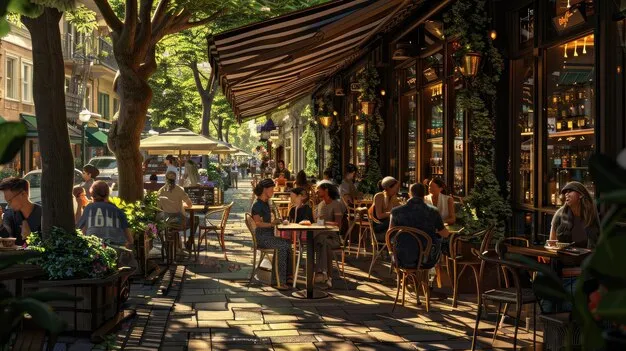
Where Do Teenagers Actually Go? The Neighborhood Design Flaw That's Leaving Gen Z With Nowhere to Be
Ask a teenager in most American suburbs where they hang out, and you'll probably get a shrug. "I don't know. Someone's basement. The parking lot behind Chick-fil-A. Wherever."
Ask a teenager who lives in a well-designed walkable community, and you'll get a very different answer — specific, enthusiastic, and often involving places adults didn't even plan for them.
The difference isn't the teenagers. It's the neighborhood.
The Invisible Age Group in Neighborhood Design
Urban planners spend a lot of time thinking about families with young children and about seniors. They think about traffic flow, school zones, and accessibility. But teenagers — that awkward, loud, intensely social age group between 12 and 18 — tend to fall through the cracks.
They're too old for playgrounds. Too young for bars. They don't have cars (mostly), they don't have money (mostly), and they have an enormous amount of social energy with nowhere obvious to put it.
In car-dependent suburbs, the result is predictable: they go inside. They go online. They sit in bedrooms and scroll, not because they prefer it, but because the neighborhood has left them no real alternative.
"There's literally nothing to do here unless someone drives you somewhere," says Maya, 16, who lives in a subdivision outside a mid-sized Southern city. "Everything fun is like 20 minutes away and you need an adult to get there. So you just... stay home."
What Teenagers Actually Want (Hint: It's Not a Teen Center)
Here's what a lot of well-meaning adults get wrong: they assume teenagers want dedicated teen spaces. Teen centers. Youth rooms. Supervised hangout zones with ping-pong tables and motivational posters.
They don't. Or at least, that's not what makes a neighborhood feel alive to a 15-year-old.
What teenagers actually want is what everyone wants: to feel like they belong in a place. To be able to show up somewhere without needing a parent's schedule to align. To have agency over where they go and how they get there.
"I want to be able to walk somewhere," says Jordan, 17, from a mixed-use community in the Pacific Northwest. "Like, just leave my house and go somewhere that isn't just another neighborhood. A coffee shop. A park with actual stuff in it. Somewhere I can run into people."
That word — walkable — comes up constantly when you talk to teenagers about what they want from a neighborhood. Not because they've read urban planning literature, but because they've experienced the alternative, and the alternative is isolation.
The Design Elements That Actually Work
Communities that successfully engage teenagers tend to share a few specific features — and most of them weren't designed exclusively for teens.
Mixed-use ground floors. When a neighborhood has coffee shops, small restaurants, bookstores, or game stores within walking distance, teenagers show up. Not because anyone invited them, but because those are places where it's socially acceptable to exist for an hour without spending much. The key word is mixed — places where teenagers share space with adults naturally, rather than being segregated into a designated "youth zone."
Safe, interesting streets. Teenagers walk and bike more than almost any other demographic — when the infrastructure allows it. Wide sidewalks, protected bike lanes, and streets designed for people rather than just cars give teenagers the independence they're developmentally primed to seek. When a 14-year-old can bike to a friend's house without a parent worrying about safety, that's a neighborhood doing something right.
Parks that aren't just for little kids. A swing set and a slide is not a park for a teenager. Open fields, skate-friendly surfaces, courts for basketball or volleyball, and seating areas where groups can actually gather — these are the features that bring older kids outside and keep them there.
Third places with low financial barriers. A library. A community green. A plaza with benches and shade. Not every hangout needs to cost money, and teenagers — who rarely have much of it — are especially sensitive to spaces where their presence isn't contingent on a purchase.
The Screen Time Connection
It's become fashionable to blame smartphones for teenage isolation. And screens are certainly a factor. But there's a compelling argument that the causation runs in the other direction: teenagers are on their phones so much partly because their physical environment offers so little.
Research from the American Psychological Association suggests that adolescents who have access to walkable neighborhoods and third places show lower rates of social anxiety and depression than those in car-dependent areas — even when controlling for socioeconomic factors. The neighborhood isn't just a backdrop. It's actively shaping how teenagers develop socially.
When a 16-year-old can walk to a coffee shop and run into a classmate, that's an unscripted social interaction — the kind that builds real relationship skills. When the only alternative is a group chat, something is genuinely lost.
What Teenagers Are Telling Us About What We've Built
Talk to enough teenagers and a pattern emerges. The ones who live in walkable, mixed-use communities describe their neighborhoods with a kind of ownership. "My neighborhood." "My coffee shop." "The park where we always go."
The ones in isolated suburbs describe their neighborhoods as something that happens to them. A place they're stuck in until they can drive.
That distinction matters. A teenager who feels a sense of belonging in their physical community is building something that will serve them for the rest of their life — a relationship to place, to neighbors, to the simple act of showing up somewhere and being part of something.
At Front Street Village, we think about that a lot. Because designing for community doesn't just mean designing for the adults who buy homes. It means designing for the teenagers who are going to define what that community actually feels like to live in.